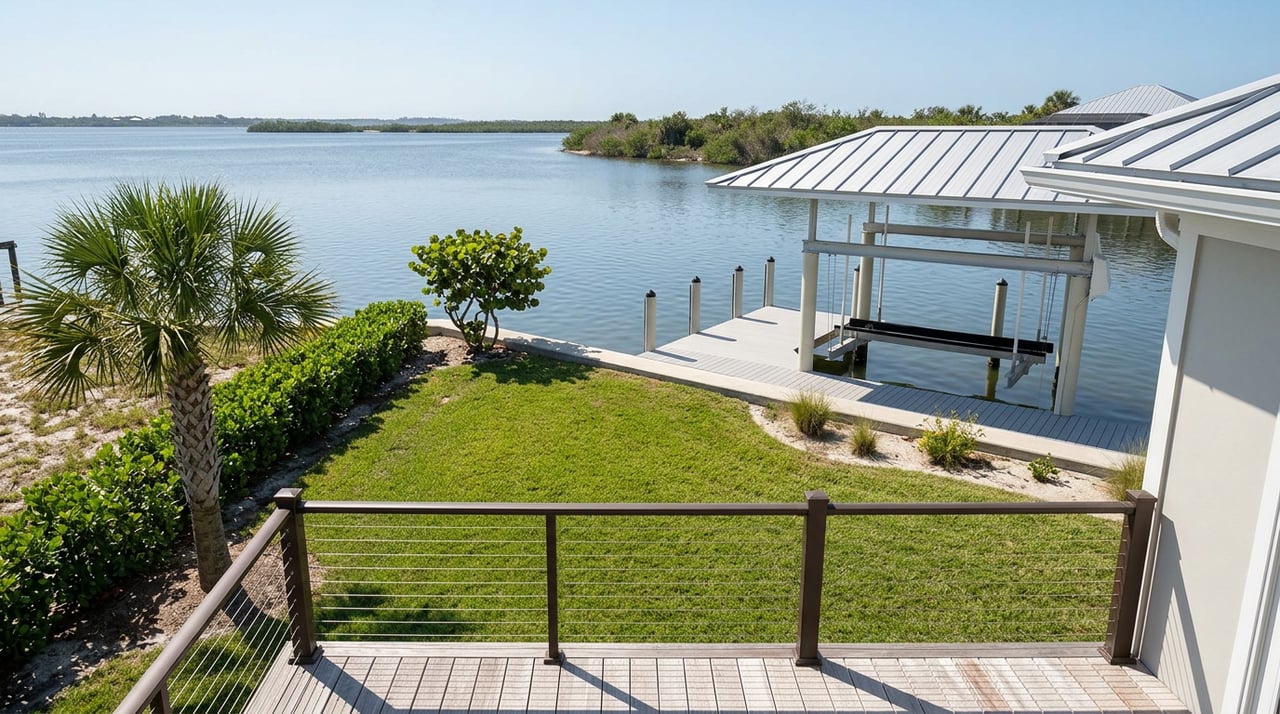
Florida State Parks lists Don Pedro Island State Park as open, including the island, while noting that the dock and facilities are unavailable. For people who have lived on the Cape Haze peninsula for a while, that update may be familiar: many have reached the island without relying on the public dock.
Don Pedro Island State Park sits offshore from the peninsula, reachable only by water, split between a hundred-acre land base at 8450 Placida Road and the barrier island itself, a mile of Gulf-facing sand between Knight Island and Little Gasparilla. When the bay-side dock and its facilities went offline earlier this year, the practical question for anyone who actually lives here wasn't whether the island was still worth visiting. It was which of the half-dozen ways you already had to get there still worked.
Park status and dock access
The distinction matters because the park's land base and the island are two different logistics problems. The land base, the part most people drive to, still has its kayak launch, fishing dock, and nature trails running normally. The island, the part with the actual mile of beach, is the piece that lost its landing point.
That's a meaningful gap for day-trippers who used to plan around tying up at the state dock. Residents who already use other access options may not need to change their plans. The channel to the bay-side dock runs south of the Cape Haze power line crossing and stays under three feet deep in stretches, shallow enough that most people who go regularly already know to idle through it.
How the peninsula actually gets there
Ask around Cape Haze how people reach Don Pedro this season and you'll get a short list, not a shrug:
- Private boat, threading the marked channel from the Intracoastal at green marker #35, same shallow-water caution as always.
- Kayak or paddleboard, either your own or a rental from SUP Englewood, which also runs guided crossings by reservation.
- A private water taxi, the kind Boat to Beach has been running across the channel for years, booked ahead rather than found dockside.
- A chartered passenger ferry, the sort Grande Tours out of Placida arranges for small groups heading over for the day.
None of these routes touch the disabled dock at all. The island's access has included small operators and private boat owners as well as the public dock. Visitors who planned around the state dock may need to consider another option; residents who already use other arrangements may not need to change their plans.
The dockage benefit nobody outside the gate hears about
There's another reason some Cape Haze locals may not need to change their plans. The Cape Haze Property Owners Association traces its roots to 1951, when brothers William and Alfred Vanderbilt began turning an undeveloped stretch of the peninsula into what they called the 2-V Ranch. What grew out of that ranch was a waterfront community built around canals and Sarasota School architecture, and one of the standing perks CHPOA still offers its members today is private dockage access at Don Pedro Island and the Gulf beach beyond it, alongside a recently renovated Community Center with a screened patio for the association's social calendar.
That's worth sitting with for a second. The community's own private dockage arrangement isn't a workaround for the state park's outage. It's a separate benefit entirely, tied to the association rather than to any public pier, and it keeps functioning exactly as it always has regardless of what happens to the state park's bay-side dock. If you're inside the association and you've never used that benefit, this is the season it's worth asking about.
Down the road, a corner changes hands without changing much
While the island access story played out mostly on the water, the more visible shift for anyone driving Cape Haze Drive has been at street level. The building at 3745 Cape Haze Dr in Rotonda West spent years as Cape Haze Tavern, an upscale seafood-and-New-American spot known for its back room, a dim, plush lounge called The Rabbit Hole that hosted piano nights and old-movie screenings. Sometime after the Tavern closed, Lipinski's Tavern opened in the same building, a few months later by most accounts, with a menu that leans into Polish comfort food alongside its seafood.
What didn't change is the part regulars seem to have cared about most. The Rabbit Hole is still there, still doing double duty as a late-night lounge, now folded into Lipinski's under the same name. Lipinski's keeps a tighter schedule than its predecessor did, open noon to 9pm Tuesday through Saturday and 10am to 3pm on Sundays, closed Mondays. If your dinner routine used to route through that building on a Tuesday night, the address hasn't moved even if the kitchen has.
For the days you'd rather not get wet
Not every stretch of the peninsula requires a boat, a channel marker, or a tide table. The Cape Haze Pioneer Trail runs through the peninsula's residential core as a legacy of an older industry entirely, built along a rail corridor once used for phosphate mining. It's now a protected greenway threading through neighborhoods that have nothing to do with the island access questions above, which makes it the easiest daily-life answer on this list: no reservation, no channel depth to think about, just a paved stretch through the part of Cape Haze most people actually walk their dogs.
What this season actually looks like
Put together, the picture of Cape Haze right now includes a public dock outage and a restaurant transition. Access to Don Pedro includes private boats, a couple of small charter operators, and a homeowners' association benefit that runs entirely independent of the state park's dock. The tavern on the corner changed its name and its menu without touching the room people actually go back for. That's one part of what's new if you already live here: a reminder of how much of daily life on this peninsula runs through options beyond the public dock.
If you're weighing whether your own waterfront access, whether it's a private dock, a CHPOA membership, or a boat slip that came with the house, still makes sense for how you actually use the water these days, that's the kind of hyperlocal question Melissa Csank at MyBocaGrandeHome fields all the time from neighbors up and down the peninsula. Schedule a Private Consultation whenever you're ready to talk through it.